
Ecology
Geoffrey Bawa developed an architectural approach that worked with, rather than against, the local surroundings, designing buildings with a strong sense of place and environmental sensibility. His vision for protecting the natural landscape is not only apparent throughout his career, but also extended beyond his commissioned work and into his own properties.
Bawa purchased Lunuganga in 1948, imagining it as “a garden within a larger garden,” seamlessly connected to its surrounding landscape. Over more than four decades, he shaped the estate by integrating existing terrain, vegetation, and habitats into its design. This approach continues today through the work of the Lunuganga Trust, which stewards Geoffrey Bawa’s Living Collection of over 300 native and exotic plant species.
Beyond the garden, the Trust also manages the Honduwa and Appaladuwa islands in Dedduwa Lake, located just offshore from Lunuganga. Acquired by Bawa in the early 1960s, these islands were set aside for wildlife protection and continue to support vital ecosystems, providing habitat for over 30 nationally threatened plant and animal species.
Today, the Lunuganga Trust collaborates with individuals and organisations in Sri Lanka and internationally on the research, care, and preservation of its Living Collections, while supporting wider ecological research and environmental conservation initiatives across the island. Further details are outlined below.
“The [Honduwa] island is full of bird life and is now a bird sanctuary”
— Geoffrey Bawa
Featured projects
-
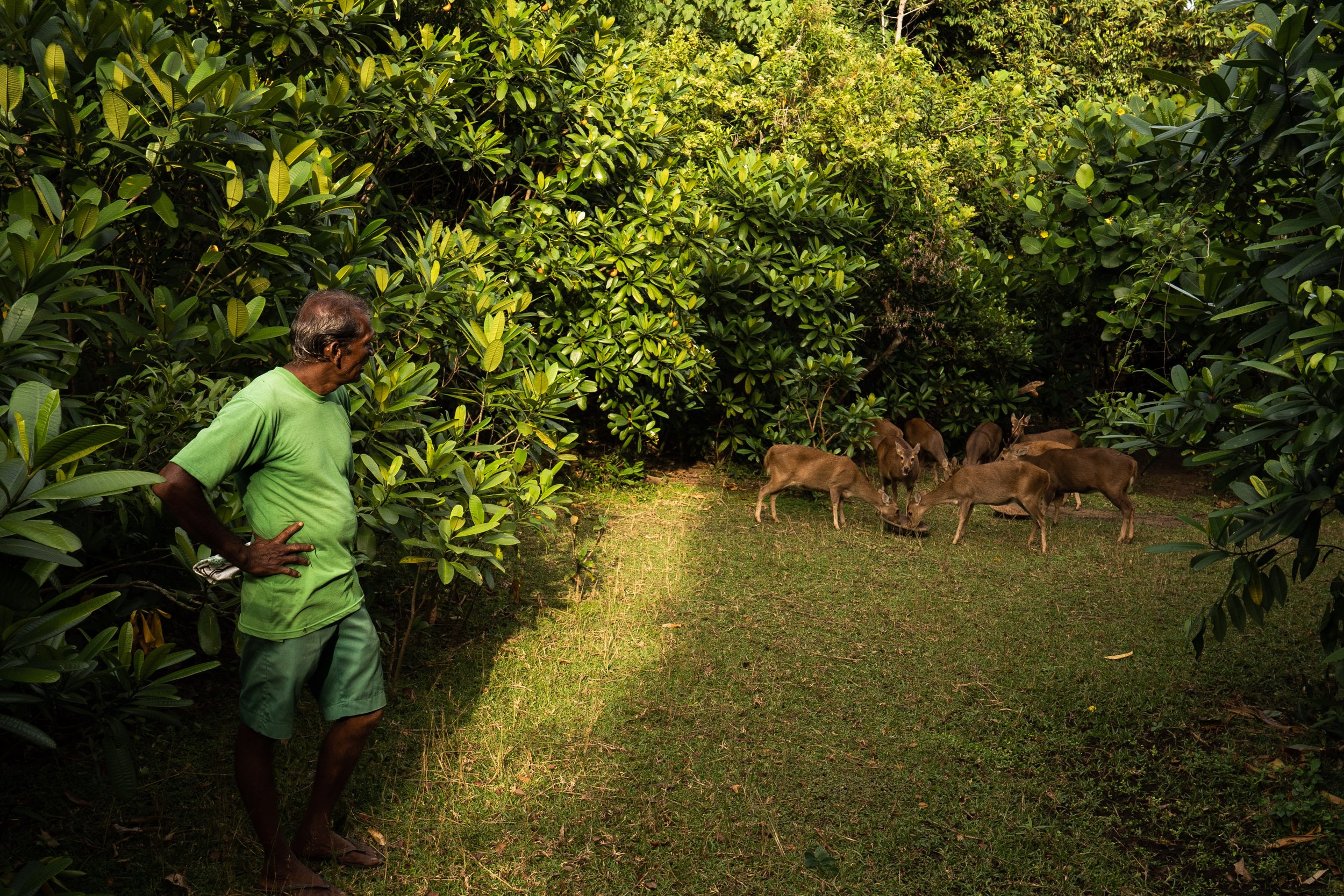
In 2013, the Trust established a sanctuary for the critically endangered Hog Deer (Axis porcinus) on Honduwa Island, in partnership with the Department of Wildlife Conservation. After more than a decade of conservation work on the island, the initial population of just eight, has grown to a total of 32 Hog Deer at present.
Following the success of this flagship project, the Trust launched a partnership in 2025 with the Wildlife and Nature Protection Society of Sri Lanka to increase ecological restoration on the island and work towards reintroducing the growing deer population back into the wild. This initiative also aims to protect a whole range of threatened biodiversity which exists on the island, including the Indian Pangolin, Fishing Cat, Rusty Spotted Cat, and over 17 species of endangered flora. The project has been supported by scientific research conducted by the University of Peradeniya and the University of Sri Jayawardenapura.
This project is supported by generous grants from the Lanka Environment Fund and Deutsche Bank.
-
Tropical gardens globally are significant. Their distinct design and horticulture is shaped by and is a reflection of the local climate and history. They hold critical knowledge about tropical species and serve as transitional spaces between wild ecosystems, and human-centric or urban spaces. These gardens, however, face unique challenges when it comes to protecting built and natural heritage, promoting biodiversity, and adapting to climate change.
Since May 2025, the Lunuganga Trust has worked with the International National Trusts Organisation to bring together tropical and subtropical gardens from around the world. This is a unique global platform where the community can learn from each-other, share experiences, and shape policies and best-practices for the future. At present, the working group includes member-gardens from Barbados, India, Malaysia, Maldives, Sri Lanka, St Helena, Thailand, and Zimbabwe.
-
Geoffrey Bawa advocated for bringing ecology into multi-disciplinary conversations. The Trust is continuing and expanding on this vision through a series of quarterly lectures designed to increase dialogue across practices and sectors, and engage the general public in ecology-focused or environmental discussions.
The ongoing series explores topics such as ecological restoration, wildlife management, sustainable urban development, indigenous and traditional knowledge, and other related areas.
For details of the next upcoming talk, click here.